

Opening Track
The week in review
This week, the United States declines to renew CUSMA for another 16 years, while concerns over the Federal Reserve's independence re-emerge.
Download slides
Top of the Charts
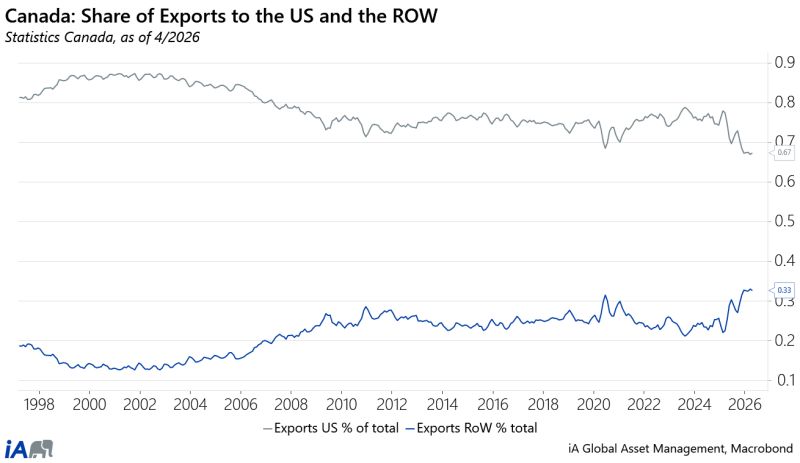
Chart of the Week | Canada Looks Beyond the U.S.
July 1 is approaching, along with the scheduled date to decide whether CUSMA will be renewed as is for another 16 years.
We probably should not expect a grand moment of trade stability, with a simple and reassuring renewal of the North American agreement. The more likely scenario looks like a process of annual reviews, meaning a trade relationship that will remain important, but also more uncertain.
For Canada, this is a rather blunt reminder of a well-known reality: you do not get to choose your geography.
The United States will remain our main trading partner. The depth of the American market, proximity, integrated supply chains and decades of trade habits will not disappear just because the political climate changes.
But this week’s chart shows something encouraging: without turning its back on the United States, Canada is trading more and more with the rest of the world.
Until 2024, the split in Canadian exports was roughly 75% to the United States and 25% to other trading partners.
Today, it is closer to 67% and 33%.
This shift could easily be misread. One might think the U.S. share is falling because exports to the United States are dropping sharply.
That is not the case.
In April 2026, Canadian exports to the United States stood at around $46 billion, very close to the average level observed between 2022 and 2024.
The real story is elsewhere.
Exports to the rest of the world are clearly rising: from an average of about $15 billion per month between 2022 and 2024, they reached $21 billion in April.
In other words, Canada’s trade diversification is not just a percentage effect. It reflects a very real increase in sales to other markets.
The north-south relationship will remain dominant. But it is gradually becoming less exclusive.

New Releases
Read our latest publications
White Paper #2 on AI
Learn to fly: The AI productivity J curve and why the data are still idling on the runway
Read here
Featured on Air
Quick access to our latest media appearances